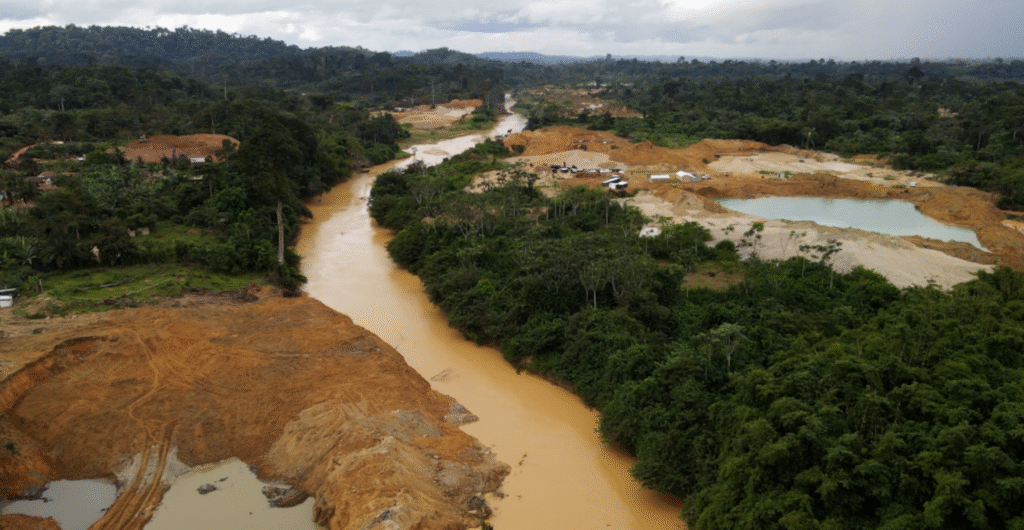
Years of Galamsey, (unregulated or illegal mining), have left Ghana and many other West African countries with an unpleasant side effect. These activities have unleashed a monster, a truly silent killer: heavy metal poisoning.
Gold keeps strange bedfellows and is often found in rock and soil layers that are laden with arsenic, cadmium, lead, and naturally occurring mercury.
These heavy metals get stirred up when the soil is disturbed during gold mining operations, and end up in loose piles of dirt, which then get washed as silts into local rivers.
Downstream, these silty rivers are the source of drinking water for villages and towns. The dangerous compounds even reach treatment plants feeding entire cities.
To make matters worse, mercury is often used in these mining operations to agglomerate the gold, and the imported mercury also finds its way into the waterways and rivers.
Liquid mercury, by itself, is toxic, causing severe neurological, kidney, and liver damage, but when fish eat it, it begins to build up in their tissue as monomethylmercury. The same thing happens when livestock drink from water or eat plants containing mercury.
Mercury that settles into the silts at the bottom of the rivers becomes a target of bacteria that convert it into dimethylmercury. This alcohol-like molecule is one of the most deadly known to humanity. Tiny traces can destroy health forever in short periods of time. A single small drop can kill through a latex glove barrier.
The heavy metals, especially the mercury, can cause severe issues for a developing child both before and after birth. Dimethylmercury passes through not only water filters and sand bed filters, but even Reverse Osmosis (RO) treatment plants.
In the western US, the 5E team of energy and water innovators has been developing technologies for many years targeting niche markets like offshore wind energy, specialized island solar, waste to fuels, waste to electricity and specialized water treatment. Working with government leaders around the world, it has developed and perfected some remarkably effective and efficient ways of cleaning water and have found energy solutions from waste for places not tied to large power grids.

Johnny Kraczek, President of 5 Element Energy and Environmental Systems, (5E), is not only a CEO, but also a Father and Grandfather. Johnny uses the battle cry “For the Children of the World” to generate the personal energy to take on new projects, especially those that will make the world a better place for the next generation. Many of the technologies and projects his companies have developed over the years have a decided humanitarian and environmental intent.
Kraczek shares the story of how he was introduced to the water problem in Ghana:

“When one of my sons-in-law, Garth Talbot, was still at university, he went with some of his professors and a Nurse Scientist, Cassis Boateng, to Ghana as part of a project studying statistics. Boateng is Ghanaian and has many connections and family there. While in Ghana, they met some of the government ministers, not just in education, but also in agriculture and health.
“The ministers shared concerns about the Galamsey problem and the toxic mercury levels in some of the water sources.
“Talbot knew that 5E had worked on contaminated water before; and, realizing how important this work was, he brought the Ghana water problem back to us.
“We had been developing a system for pulling mercury and dimethylmercury from seawater in the Dominican Republic and realized some technologies could cross over to Africa.
“When Talbot and Boateng discussed our possible 5E solutions, Boateng decided to come to our facilities and see for himself. He has consistently encouraged 5E to take on the Ghana water challenge. In fact, he has generously funded parts and materials for the project.”
So, what is the solution for Ghana? How do you get the mercury and other heavy metals out of drinking water for humans and livestock? Especially the dimethylmercury, which can pass through filters and membranes? Through the 5E hybrid system using several technologies! These include specialized RO, Vacuum Distillation, and Super Critical Water Oxidation, with a new form of vacuum distillation forming the heart of the system. This technology can boil and distill water with moderately low heating temperatures. The system uses Super Critical Water Oxidation to destroy any captured dimethylmercury, turning it into mercury oxide.
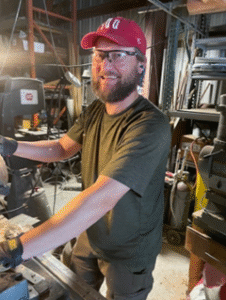
Professional Process Engineer Anthony Coulam, one of the 5E Directors, explains the heart of the 5E system, Vacuum Distillation, like this:
“At sea level, water boils at 100 °C (212 °F). But if we put that water under vacuum, we can get it to boil at 50 °C. And there are lots of places to get 50 °C heat, from solar hot water heaters to the exhaust from generators. Even a black pipe in equatorial sunlight will get that hot.”
So, a key piece of the 5E solution uses a vacuum distillation process running on lower temperature heat.
Analytical Chemist Dr. Jessica Higgs, another 5E founding member, points out that there are technical challenges that this technology has had to overcome to be effective:
“First, one of the really tough things about dimethylmercury is that it boils at a lower temperature than water itself. Second, river water loaded with silts tends to clog up and slow down the boiling rate as minerals build up on the sides of a boiler.”
It has taken a few years for the 5E team to figure out how to overcome these technical challenges, but it is now very confident in the tested solution.
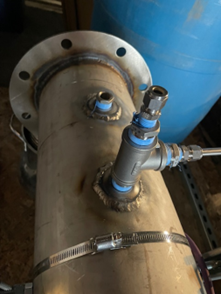
“We are building a demonstration Vacuum Evaporator for Ghana,” Kraczek explains. “We built a smaller demonstration unit a few months ago that worked well. We are now building a step up toward a commercial grade and size.”
“Looking at this unit we are building, one can imagine many of them side by side and realize they can process a great deal of water.” Dr. Higgs explains.
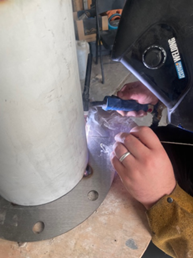
Yet, building the commercial unit has not been without challenges. On the recommendation of a materials scientist and engineer, the 5E team decided to move from stainless steel inner parts to a modern tech material with high heat transfer rate and much more wearability than stainless steel.
“We ordered the new material, at least we thought we had ordered what we wanted. But after casting and kiln firing the parts, we discovered that the heat transfer was very low,” explains Anthony. “We had to go back to our supplier and then to the manufacturer to learn that this particular compound was made for building casting molds for molten metal. In the end, it was not a fit for our application. When we started to talk to other suppliers and part manufacturers, we were amazed at how much money people wanted for parts made out of this material. Like break the budget amounts of cost.”